


As the global economy prepares for an unprecedented transfer of wealth and ownership over the next decade, a significant, yet often overlooked, threat is poised to impact many of the world’s most successful business families. While billions continue to be spent on legal, tax, and investment advice, research increasingly suggests that the keys to successful family business transitions are not only financial or structural, but also emotional.
According to a 2026 report by family coaching and advisory firm Veritage International, The Missing Link in Family Business Transitions: How Emotional Disconnection Threatens Family Legacy, the challenge lies in a growing disconnect between generations. Drawing on responses from 35 founders and current owners and 42 next-generation members across the globe, the research highlighted a clear divide in emotional and relational dynamics among family business leaders and their successors.
The report emphasises the importance of a strategy that incorporates emotional governance and professional coaching to help families align generational perspectives and ultimately protect their valued legacy.
Skills Friction
One of the most notable findings of Veritage’s report is the fundamental disagreement between generations over what it means to be prepared for a transition of ownership. Founders and current owners tend to define transitional readiness through traditional “hard” skills and values, such as fiscal responsibility, financial literacy, university degrees, and demonstrated leadership through challenging business decisions.
Conversely, the next generation is placing greater emphasis on “soft” skills, prioritising emotional maturity over corporate acuity. While many possess world-class education and work experience, they believe being comfortable with one’s identity and role within the family is what defines a successful successor.
The Barrier to Advancement
The disconnect in how readiness is evaluated between generations is directly impacting the timing and success of family business transitions. More than half of the founders and current leaders surveyed indicated they were worried about ceding control of their business, with responses ranging from “somewhat” to “very” concerned. The belief that the next generation is not yet ready accounted for the majority of reservations (34%), while the view that founders and current leaders still have much to contribute followed at 29%.
However, the next generation sees the situation through an entirely different lens. Many overwhelmingly point to the refusal by the founder or current leader to let go of the business as the primary barrier to their own advancement. The result is a clear impasse: founders and current leaders wait for hard-skill milestones that may never materialise, while next-generation members feel impeded by a lack of opportunity to step into a leadership role.
Illusion of Inclusion
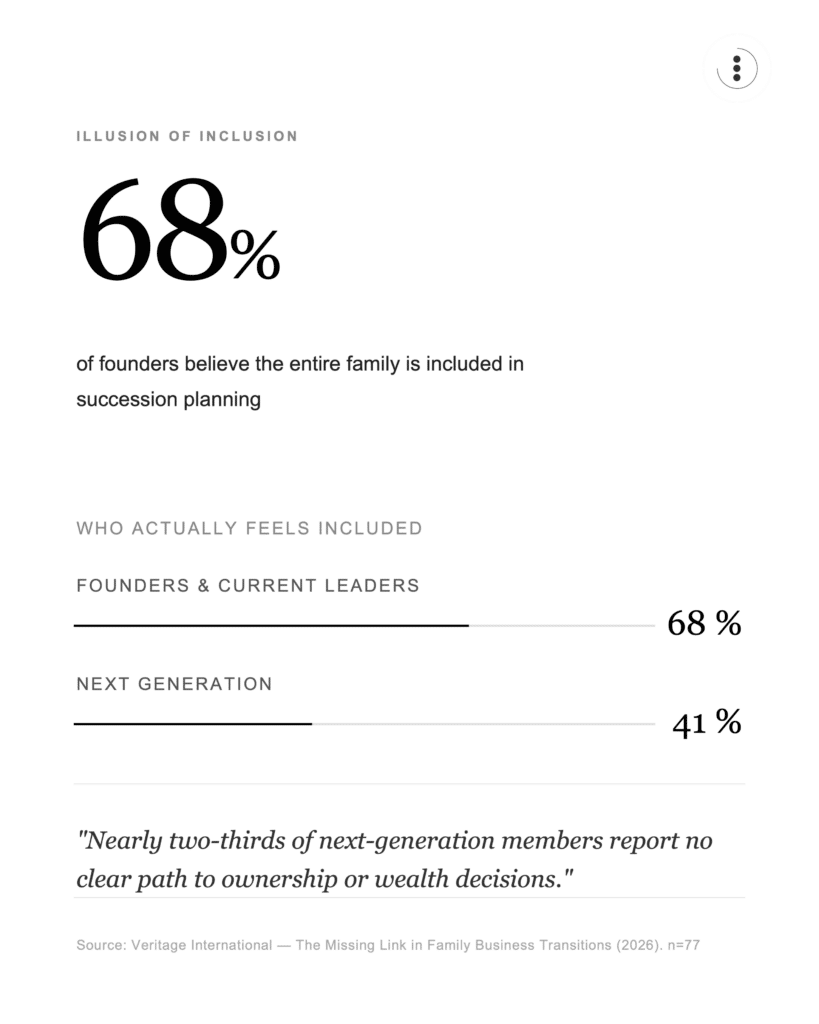
A key challenge highlighted in the Family Business Transitions report is the generational disparity in perceived inclusion and transparency. When asked whether the entire family was included in the succession and transition process, 68% of founders and current leaders responded in the affirmative, compared with just 41% of next-generation members.
This gap is further underscored by the finding that nearly two-thirds of the next-generation respondents reported that there was no clear path for them to gain ownership or participate in critical wealth decisions – pointing to a significant misalignment in how inclusion is both communicated and experienced.
A Missing Emotional Governance Strategy
Veritage’s research found that most wealthy families have robust governance and shareholders’ agreements – such as wills and investment policies – that fail to address the human element in leadership succession. While 55% of founders and current leaders and 41% of next-generation members report having governance documents for wealth transfer, 64% of founders and current leaders and 76% of next-generation respondents say they do not address emotional issues or family dynamics.
In the absence of a strong multigenerational emotional connection, founders and current leaders often cite entitlement and rivalry as the primary challenges they face with their children. In contrast, the next generation points to a lack of communication and control as their most significant barriers.The Hidden Crisis
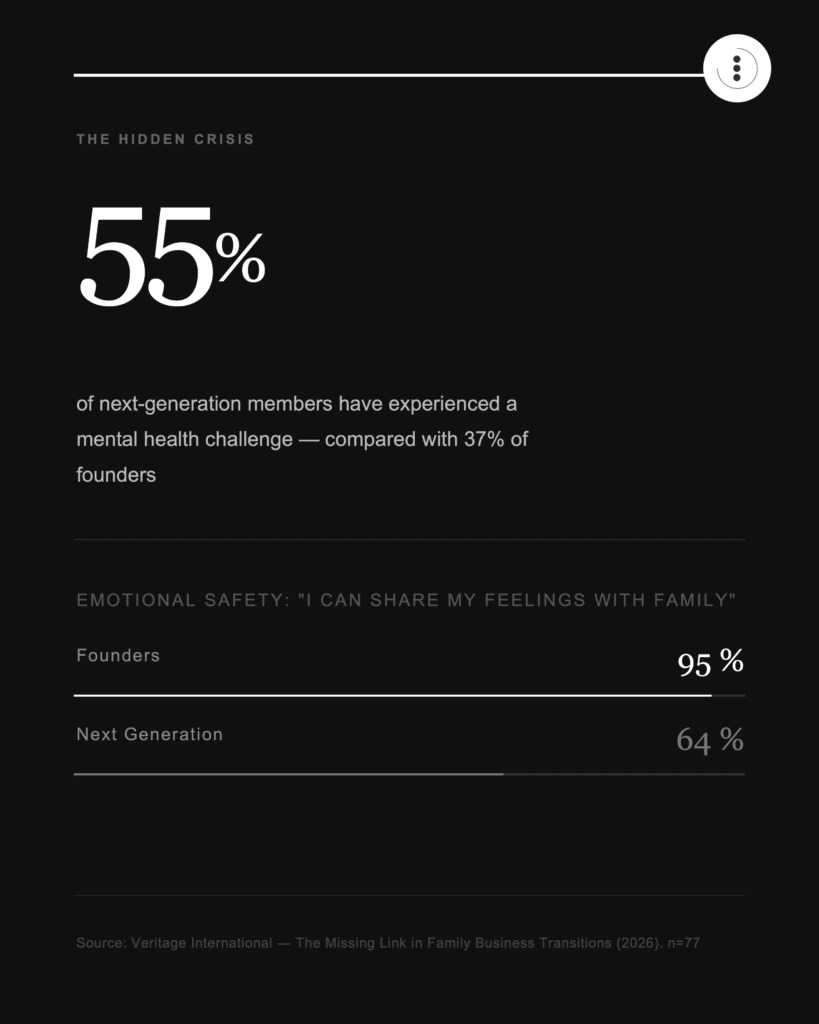
The 2026 Family Business Transitions report also brings attention to a critical issue that families need to address: mental health. The findings show that 55% of next-generation members have experienced a mental health challenge, compared with 37% of founders and current leaders.
While both generations report significant business-related performance pressures, the next generation feels considerably less safe sharing their feelings with family members. Only 64% say they feel emotionally safe discussing performance pressure, compared with 95% of founders and current leaders.
Moving Forward by Prioritising Human Capital
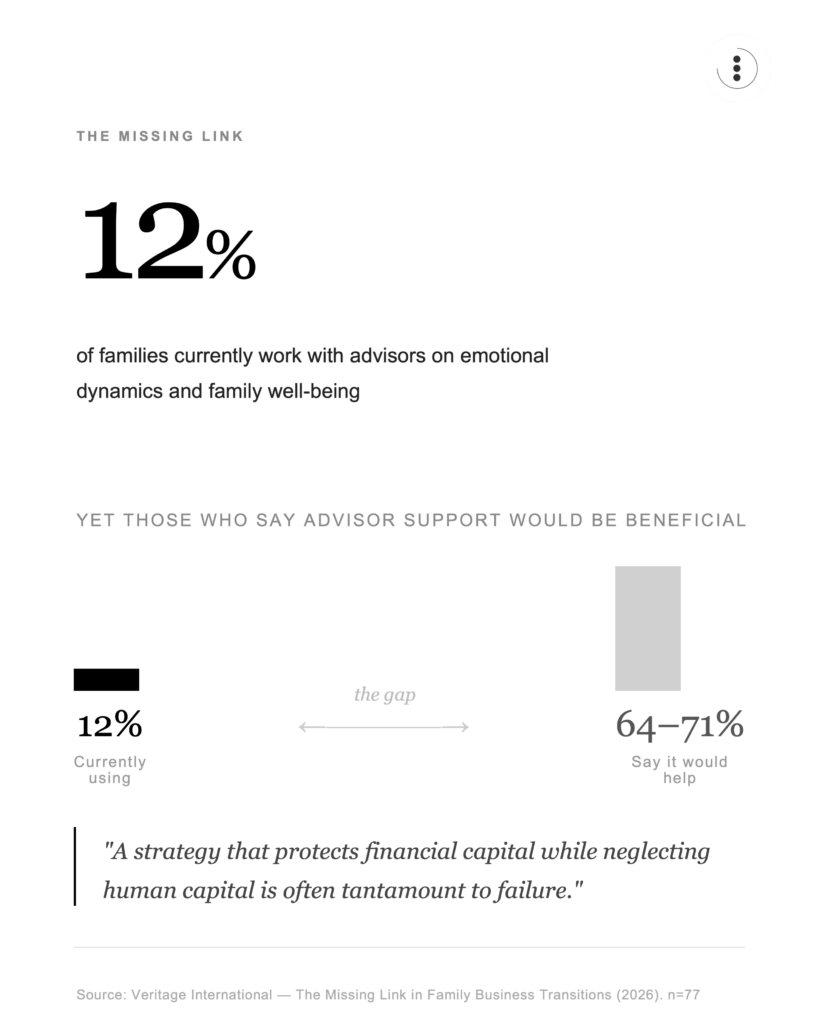
The Missing Link in Family Business Transitions: How Emotional Disconnection Threatens Family Legacyunderscores how the current approach to business transitions remains perilously uneven for many families. A strategy that focuses primarily on tax and legal structures to protect a family’s financial capital, while neglecting to prepare the human capital tasked with stewarding that wealth, is often tantamount to failure.
To bridge this gap, Veritage suggests a shift toward more unified decision-making grounded in emotional safety. This begins with recognising recurring tension or avoidance in meetings, and acknowledging that even the strongest families carry emotional baggage. It requires honesty about what remains unsaid and a willingness to create space for open, blameless dialogue – and crucially, families should consider seeking external support. While only 12% of the surveyed families were working with advisors on emotional dynamics, between 64% and 71% admit that such support would be beneficial.
Ultimately, Veritage’s research suggests that neither generation is emotionally equipped for the inevitable and consequential wealth transfer in the coming years. Without greater investment in the emotional well-being of family members, the financial wealth built over a lifetime risks losing its meaning as relationships begin to fracture. The report suggests that a pivot from focusing strictly on the business to supporting the people within it is the missing link in ensuring that a family legacy not only endures, but also thrives, for generations to come.