


Over the past two decades, family offices around the world have undergone a profound transformation. Once primarily focused on investment management and asset building, they have evolved into highly sophisticated drivers of wealth and, ultimately, family legacy. This shift is explored in a recent landmark study, The Global Family Office Report, produced by the IMD Global Family Business Center in collaboration with the Family Business Network (FBN). Drawing on insights from 186 families across 41 countries in 5 continents, the research highlights the growing adoption of a polycapital approach to family wealth management – one that integrates human, social, intellectual, and reputational capital alongside traditional financial assets.
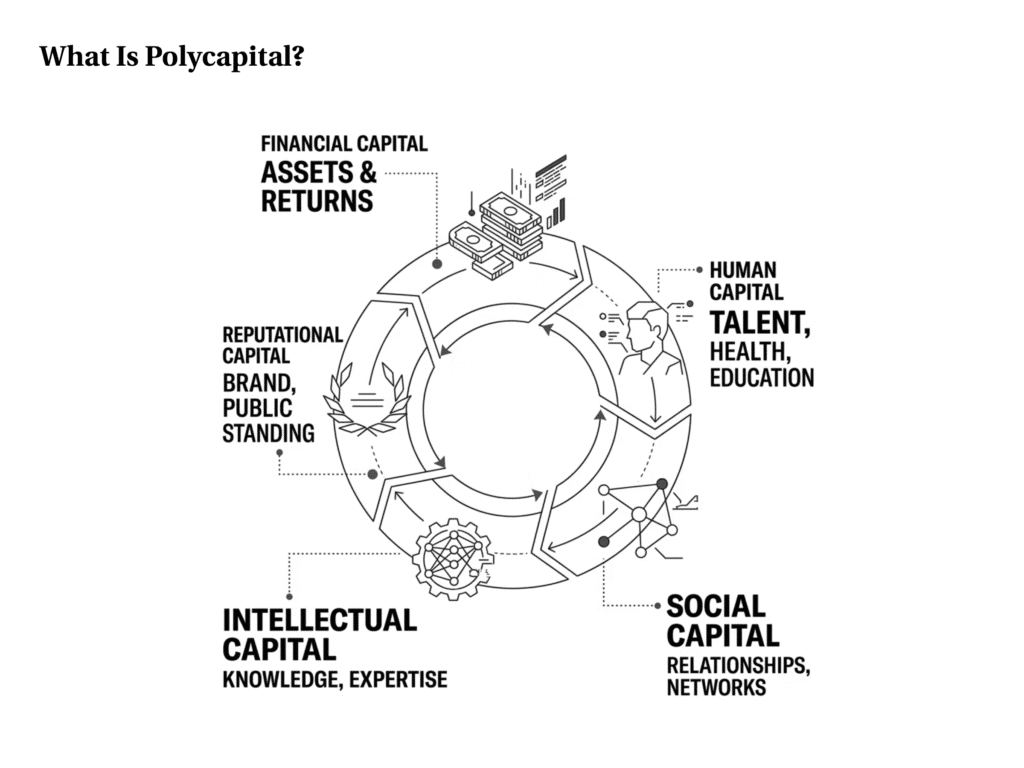
The Polycapital Framework: Modern family offices manage not only financial assets, but human, social, intellectual, and reputational capital as interconnected drivers of long-term legacy.
Founding Principles
The Global Family Office Report reveals that most family offices are established with a clear financial mandate, with wealth diversification (29%) and wealth preservation (23%) forming the primary drivers. While these financial targets remain central, the objectives of many offices have broadened over time. Just over half (51%) of survey respondents indicated their office’s ambitions have shifted since its creation, most commonly expanding to include next-generation education and governance as both short- and long-term goals.
Yet, even as objectives become more refined, the data suggests that family offices experience a significant “intent-action gap” in certain areas. For example, while 65% of families expect to increase their allocations to private equity, current actual allocations remain comparatively low at 13%. Similarly, despite being widely discussed and praised, impact investing was seldom cited as a primary founding purpose or a significant area of evolution in the report’s findings.
The Nine Identities of a Family Office
Based on their findings, the IMD Global Family Business Center and the Family Business Network identified nine distinct identities that often develop throughout the course of a family office’s lifespan:
Embedded Family Office: Integrates the family business and, in many cases, leverages company staff to handle personal pursuits.
Administrative & Compliance: A lean, cost-effective system focused on bookkeeping and “keeping the house in order.”
Investment Family Office: An actively managed structure that usually deploys specialised teams for specific investment classes, such as real estate or private equity.
Founder’s Family Office: Centred around the family wealth creator and often used to direct the liquidation of equity after a significant exit.
Family Business Family Office: Maintains a financial connection between the family and its legacy operating company.
Philanthropic Family Office: Funnels capital toward social and environmental impact causes, sometimes acting as a non-profit or for-profit hybrid.
Family Cohesion Office: Prioritises education, communication, and family unity.
Virtual or Outsourced: Functions as a flexible model that takes advantage of a network of external contributors to minimise internal overhead.
Multi-Generational Family Office: Focuses on succession and long-term family wealth stewardship.
Maturity and Scaling
The study reveals a link between the size of a family office and its level of professional maturity. As assets under management increase, families generally move outsourced services in-house to preserve control. For example, only 25% of offices with over $1 billion in assets under management (AUM) outsource their investment analytics, compared with 36% of smaller offices with less than $500 million in AUM.
Larger family offices are also significantly more likely to internalise tax, legal, and compliance functions – with 81% managing these responsibilities in-house – compared with their smaller counterparts. At the same time, however, the findings suggest that certain core activities remain under the control of the family regardless of office size: philanthropy (85%), family communication (83%), and governance oversight (86%).
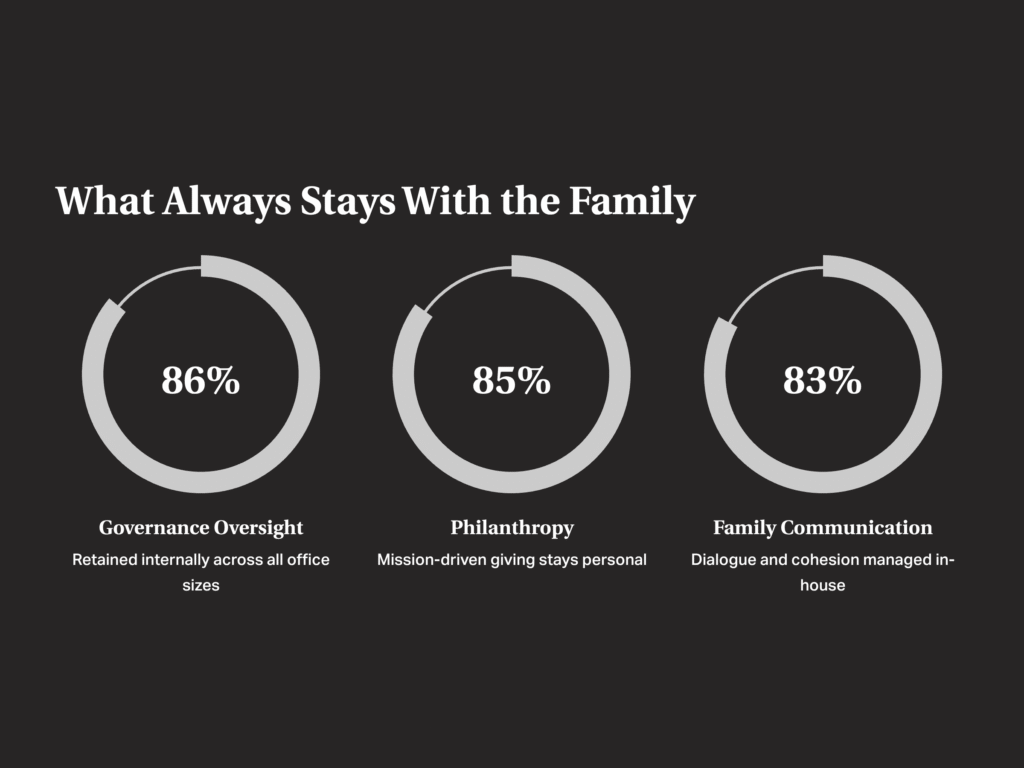
What Remains Internal: Regardless of size or maturity, governance, philanthropy, and family communication overwhelmingly remain under direct family oversight.
Historic Intergenerational Wealth Transfer
The Global Family Office Report points to an unprecedented intergenerational shift that is reshaping the family office landscape. An estimated $100 trillion is expected to transfer from Baby Boomers to their heirs over the next two decades, fundamentally altering ownership, leadership, and governance dynamics. According to the study’s findings, Generation 2 currently holds the greatest share of operational control (30%) and governance influence (39%), even as many family offices grow increasingly complex, with some serving up to 11 generations and more than 1,000 members.
This leadership transition is driving demand for new skill sets and capabilities. Survey results showed that next-generation leaders are more likely to seek expertise in ESG, digital transformation, and alternative investments. However, the report highlights the lack of preparedness that remains among many family offices, with nearly half (47%) lacking a formal wealth succession plan, highlighting a critical gap at a pivotal moment in generational change.
Leveraging Governance
Participants in the report identified governance as a mechanism increasingly used for compliance and transparency rather than a formal set of rules. While most families (68%) believe their current governance arrangements are effective, only 9% of family offices undertake external reviews of their board or office activities, suggesting a potential area of weakness. The study highlights the growing prevalence of shared control across generations, which is steadily becoming the norm, even when senior generations retain final ownership and control.
The AI and Digitalisation Disruption
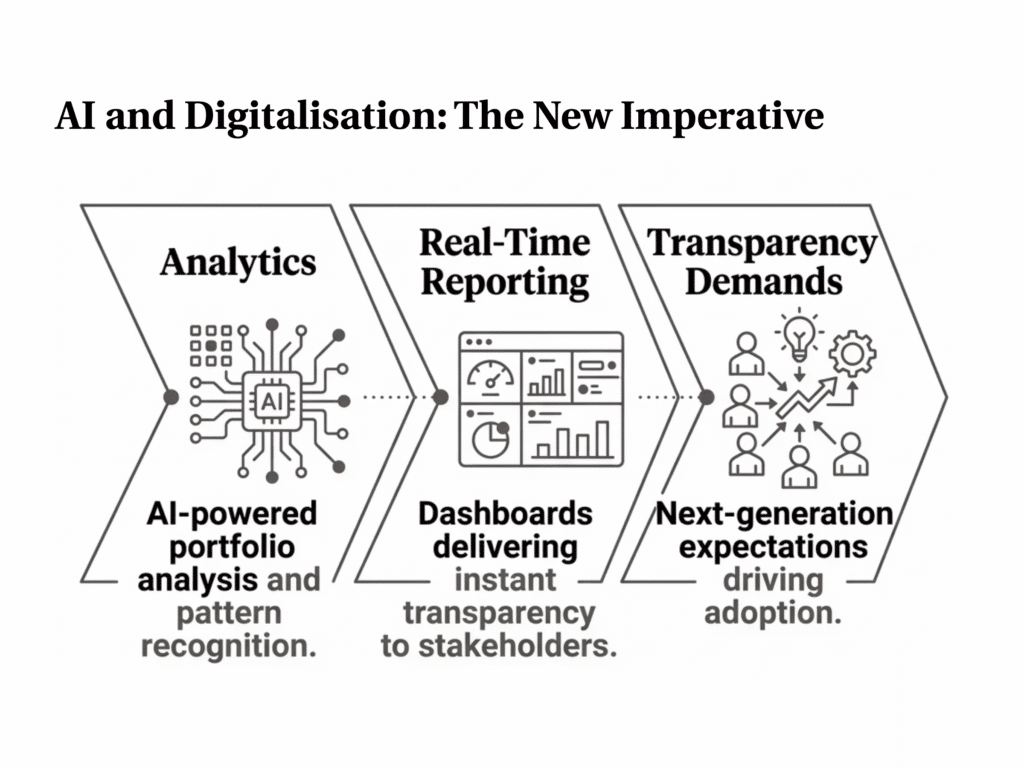
Despite the perception that family offices traditionally lag in the adoption of new technology, the digital transformation is now considered a necessity in the family office sector. Survey respondents confirmed their active use of artificial intelligence, particularly for analytics and real-time reporting. This shift reflects both a desire for efficiency and the transparency that younger family members and global regulators now demand.
Lessons for the Future
The Global Family Office Report provides several key recommendations for families looking to establish or redefine their offices. These include developing a clear purpose and governance structure, as well as transitioning from an informal, founder-led setup to a structured organisation built for long-term success and stability. Ultimately, the family office is no longer managed purely as a financial construct; instead, it is emerging as a unifying agent central to the stewardship of wealth and the creation of family legacy.