
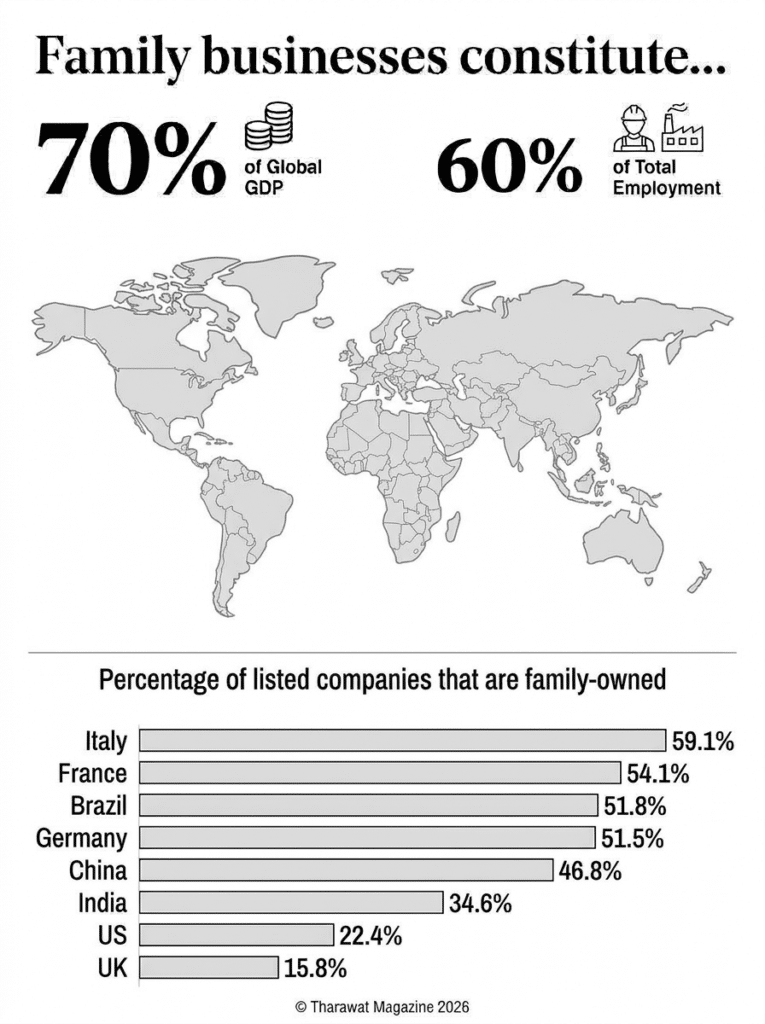
Generating more than 70% of global GDP and around 60% of total employment worldwide, family-owned businesses not only have a profound influence on economies worldwide but also drive social responsibility and innovation.
In Europe, applying a 20% voting rights threshold reveals that 43% of listed companies are family-owned, accounting for 59.1% in Italy and 54.1% in France, and 51.5% of German publicly traded firms. Meanwhile, family businesses represent 15.8% of listed companies in the UK, 34.6% in India, 46.8% in China, 51.8% in Brazil, and 22.4% in the US.
Despite these impressive economic and societal contributions, the influence and performance of family firms continue to surprise many, especially when compared with the world’s largest corporations.
Pillars of Success: Europe’s Leading Family Businesses
Europe’s 38 million businesses collectively employ around 162 million people and generate an impressive US$28 trillion in GDP. Among these, family-led Volkswagen is the region’s largest business by revenue, boasting annual returns of $348 billion. Notably, 16% of Europe’s top 25 revenue-generating companies are family firms.
Family businesses have long served as catalysts in Europe’s leading economies. In Germany, 6 of the top 20 companies by revenue are family-owned: Volkswagen (1), BMW (2), Schwarz Group (3), Bosch (8), Schaeffler (16), and Phoenix Pharma (19). Along with other family-owned firms such as Bertelsmann and Adolf Würth, these companies collectively employ 2.4 million people and represent 28% of Germany’s top 25 employers.
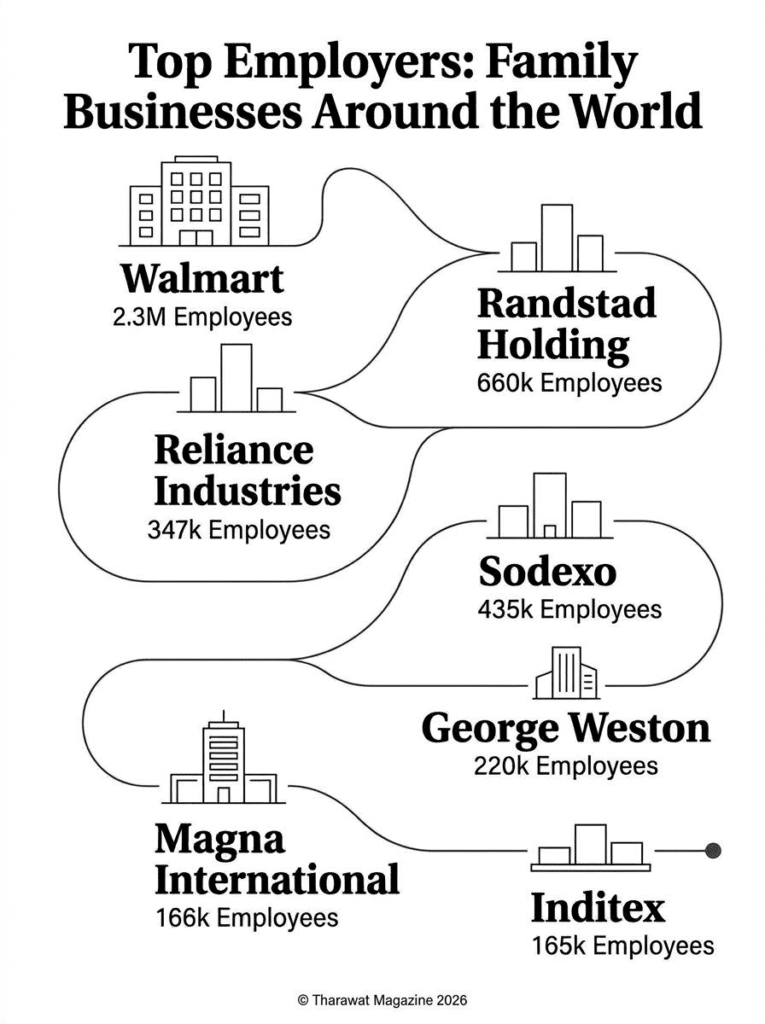
In France, 5 of the top 25 revenue-generating companies are family-controlled: LVMH (9), CMA CGM (18), L’Oreal (21), Casino Guichard Perrachon (20), and Groupe Auchan (24). Sodexo, owned by the Pierre Bellon family, stands out as the nation’s largest employer, with a workforce totalling 435,000.
Italy’s family businesses account for 30% of the top 20 companies by revenue: Ferrero International (13), Saras Group (14), Edizione Srl (15), Webuild (16), Esselunga (17), and Marcegaglia (18). They also provide substantial employment across the nation, with Edizione Srl, Webuild, and Ferrero International ranking among Italy’s top 10 employers.
In Spain, 6 family firms from the top 20 companies by revenue generate over $129 billion annually: Inditex (6), Mercadona (9), Acciona (12), El Corte Ingles (13), Corporación Gestamp (17), and Ferrovial (18). They also play a pivotal role in the economy, with Inditex’s 165,000 employees positioning it as the country’s second-largest employer.
In the Netherlands, 30% of the top businesses by revenue are family-led: Louis Dreyfus Holding (5), EXOR Group (6), Heineken Holding (11), Randstad Holding (13), SHV Holdings (15), and Jumbo Groep Holding (24). Among them, the family-owned multinational Randstad Holding tops the employment charts with 660,000 employees worldwide.
Family Empires Thriving in Asia
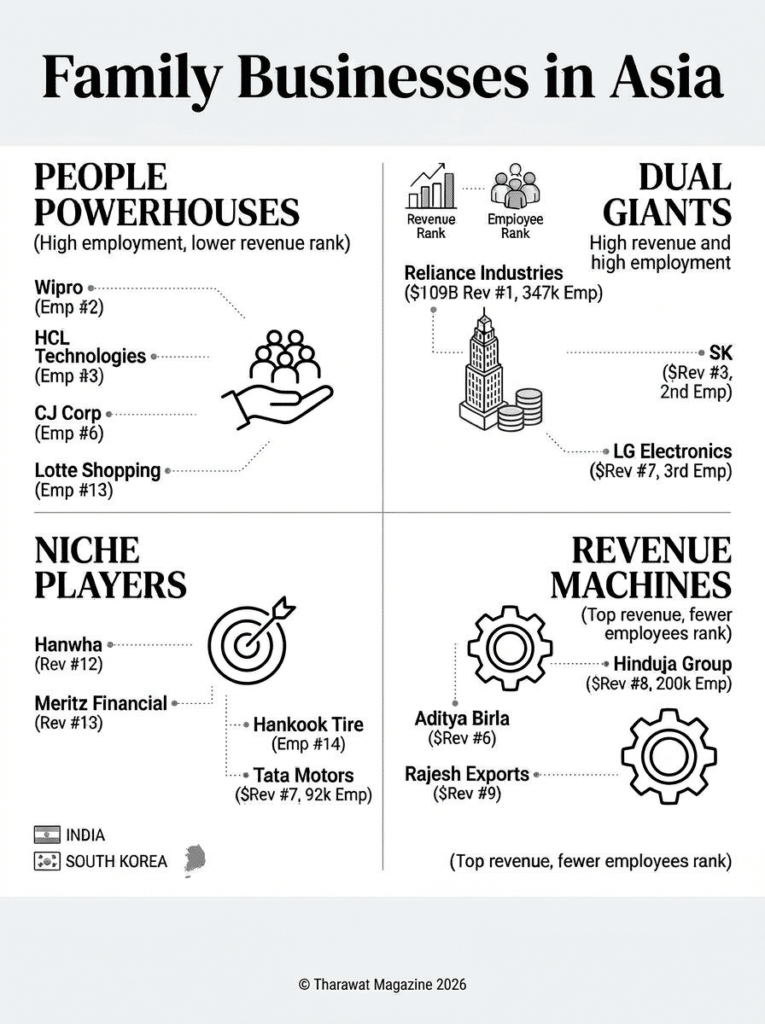
Family-owned businesses play a dominant role in Asia’s economic landscape, driving both revenue and employment. In India, family-owned Reliance Industries leads as the country’s highest revenue-generating company, bringing in US$109 billion annually. Impressively, half of India’s top 10 largest companies are family firms: Reliance Industries (1), Aditya Birla Group (6), Tata Motors (7), Hinduja Group (8), and Rajesh Exports (9). Moreover, these enterprises are among the nation’s top employers, with Reliance Industries employing 347,000 people, followed by Wipro (247,000), HCL Technologies (209,000), Hinduja Group (200,000), Aditya Birla Group (140,000), and Tata Motors (92,000).
South Korea’s economy is similarly shaped by family-owned giants. Among its top 15 revenue generators, four are family businesses: SK (3), LG Electronics (7), Hanwha (12), and Meritz Financial Group (13). Additionally, family firms drive over 30% of the country’s top employment, with notable names such as SK (2), LG Electronics (3), CJ Corporation (6), Lotte Shopping (13), and Hankook Tire & Technology Group (14) – the latter employing 20,000 people – making a significant impact on the labour market.
Family Firms Fuelling South American Commerce
In Brazil, South America’s largest economy, family-owned businesses play a vital role. The nation’s second-largest company by revenue, JBS, is family-led – and overall, family businesses represent 40% of the top 20 companies in Brazil: JBS (2), Banco Bradesco (5), Techint Group (9), Antarchile (10), Cencosud (15), Marfrig Global Food (16), S.A.C.I. Falabella (17), and Metalúrgica Gerdau (18). Impressively, just 5 of Brazil’s family businesses collectively employ over 650,000 people.
Family Empires: Powering the World’s Economic Engine
In the US, 33.2 million small businesses, many of which are family-owned, account for 99.9% of all the country’s firms. However, the US is also home to some of the world’s largest enterprises. Walmart is not only America’s largest family business but also the top revenue generator globally, with US$648 billion in annual sales. Other notable family businesses in the US include Berkshire Hathaway (5), Ford Motor Company (17), and Cargill (21). Together, Walmart (with 2.3 million employees), Berkshire Hathaway (397,000), and Publix Super Markets (253,000) employ nearly 3 million people.
Canada’s family businesses also have a strong presence, comprising nearly 30% of the nation’s top 15 largest companies by revenue: George Weston (7), Magna International (8), Fairfax Financial Holding (11), and Power Corp. of Canada (13). Food and Drug retailer George Weston is not only Canada’s largest family firm but also one of the county’s largest employers, with a workforce of 220,000. Other notable Canadian players are Magna International (166,000 employees), Empire Co Ltd (130,000), CGI Inc. (89,000), Fairfax Financial Holding (51,000), Jim Pattison Group (49,000), Power Corp. of Canada (40,000), Linamar Corporation (26,000), Rogers Communications (23,000), McCain Foods (22,000), and Saputo (19,000).
In Mexico, America Movil is the country’s second-largest family firm, generating US$46 billion in annual revenue. Impressively, 40% of Mexico’s top 15 revenue-generating businesses are family-owned: America Movil (2), Grupo Bimbo (10), ALFA (11), Grupo México (12), Arca Continental (13), and Grupo Elektra (14). These enterprises are also among Mexico’s leading employers, with America Movil (176,000), Grupo Bimbo (137,000), Organización Soriana SAB de CV (87,000), Grupo Elektra (70,000), Grupo Comercial Chedraui (63,000), Arca Continental (64,000), Alfa (55,000), Grupo Televisa SAB (47,000), Industrias Bachoco (32,000), Grupo México (29,000), and Xignux (27,000) playing pivotal roles in the employment market.
Power Players: Family Businesses Shaping Industries
Family businesses play a pivotal role in shaping and contributing to many of the world’s major industries. In the apparel sector, family-run powerhouses LVMH Moët Hennessy Louis Vuitton and Nike hold the top two revenue positions, respectively. In the financial arena, Berkshire Hathaway leads as the world’s top firm, while family-controlled Volkswagen remains the premier automotive company globally. Additionally, 5 family firms make a significant impact in the world’s motor vehicles and parts sector: Volkswagen (1), Ford Motor (4), BMW (6), Bosch (11), and Tata Motors (24).
Family enterprises also excel in other key industries. India’s Reliance Industries ranks among the global top 20 in the energy sector, and in healthcare, family-run Roche and Phoenix Pharma are included in the sector’s top 20 companies. In telecommunications, Comcast is the world’s fourth-largest company, while Walmart (1), Inditex (14), and CK Hutchison Holdings (16) are major contributors to the retail sector.
Moreover, around 20% of the top 20 companies in the food and drugs sector are family-led: Publix Super Markets (9), George Weston (10), Mercadona (17), and Jeronimo Martins (18). The influence is even more pronounced in the food, beverage, and tobacco manufacturing sector, where 30% of the top 20 companies are family firms. Notable examples include Brazil’s JBS (4) – the world’s largest meat processor – along with Anheuser-Busch InBev (7), Tyson Foods (8), Louis Dreyfus (9), New Hope (13), and Heineken (18).
Metrics That Matter: Unveiling Family Business Impact
While generating revenue and creating employment opportunities are vital metrics of success, they don’t capture the full impact of a business – especially in today’s socially conscious and environmentally aware landscape. Family businesses excel in areas such as innovation and environmental, social, and governance (ESG), placing them among the world’s top performers in these categories.
According to Forbes, family firms account for 10 of the top 50 innovative companies and nearly 20% of the world’s top 100 innovative businesses: Amorepacific (18), Marriott International (21), CP All (23), LG Household & Health Care (27), Hermès International (25), Fast Retailing (32), Anheuser-Busch InBev (37), Molson, Coors Brewing (41), Falabella (47), Dassault Systemes (48), Inditex (54), Constellation Brands (58), Kone (59), Brown-Forman (60), Sodexo (72), Bharti Airtel (92), L’Oréal Group (94), Sun Pharmaceuticals Industries (96), and The Estée Lauder Companies (97).
In the realm of ESG, three family businesses stand out among the top 10 globally: Hermes International (3), KONE Oyj (5), and L’Oréal (10). Additionally, six family-run companies feature in the Fortune’s World’s 50 Most Admired Companies: Berkshire Hathaway (5), Walmart (8), BMW (23), Nike (24), Publix Super Markets (39), and L’Oréal (41).
Global Trailblazers: Family Businesses Leading the Way
Family-owned businesses aren’t just economic powerhouses; they consistently lead the way in global commerce, innovation, and social responsibility. As the world evolves, these enterprises set benchmarks across a range of sectors, from automotive and retail to healthcare and technology, while also championing sustainability and innovation. Their resilience and adaptability have enabled them to thrive across generations, regions, and industries, navigating shifting economic, social, technological, and environmental landscapes with remarkable success.